
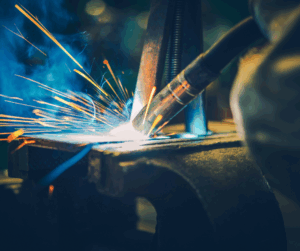
According to the World Health Organization, welding fumes are classified as a Group 1 carcinogen, putting them in the same category as asbestos and tobacco smoke. This stark reality is the foundation of a critical conversation about workplace safety in welding facilities. The fumes produced by welding are not a nuisance; they are a serious health hazard that requires a comprehensive and proactive approach. This guide will show you how to protect your team and your business by understanding and implementing effective fume extraction. It may appear as “just smoke” to many but there are several welding fumes that can pose a great danger to the health of workers. Illnesses such as “metal fume fever” and other chronic illnesses can all stem from these hazardous fumes.
The issues can extend beyond health. In fact, several business and operational concerns can come from the harm that welding fumes cause. Financial liabilities of non-compliance with regulations from OSHA as well as worker morale can be a danger if there is no suitable way to extract the fumes. This comprehensive guide will equip you with the knowledge to understand and select an effective fume extraction and exhaust system to transform your welding facility into a safe, compliant, and productive environment.
The Hidden Dangers: A Deep Dive into Welding Fumes
As mentioned before, there are several dangers within the. Let’s take a deeper look into what is inside these fumes:
-
Particulate Matter: The Heavy Metal Cocktail
- Particulate matter in welding is essentially tiny particles that one can inhale and it can penetrate deep into the lungs. The most common combinations of particulate matter in welding are the filler wire, flux, and base metal being welded.
 The most dangerous components of particulate matter are:
- Manganese (MN): Linked to neurological disorders similar to Parkinson’s disease, known as Manganism.
- Chromium (Cr): Especially Hexavalent Chromium (Cr6+), a known human carcinogen
- Nickel (Ni): Can cause respiratory sensitization and is a potential carcinogen.
- Iron Oxide (Fe2O3): Causes siderosis, a benign pneumoconiosis.
-
Gases: The Invisible Threat
- There are also several chemical reactions that can happen when doing welds.
- Ozone (O3): Formed when ultraviolet light from the arc splits oxygen molecules (O2) into individual atoms, which then recombine as O3. It is a powerful lung irritant.
- Nitrogen Oxides (NOx): Formed from the reaction of nitrogen and oxygen in the air at high temperatures and can cause acute lung injury.
- Carbon Monoxide (CO): A byproduct of incomplete combustion.
- There are also several chemical reactions that can happen when doing welds.
-
Health Effects: A Spectrum of Illnesses
- Acute Effects: “Metal Fume Fever” is a very common sickness from welding fumes and has symptoms much like the flu. One can experience fever, chill, nausea, headaches, and fatigue. Typically, the symptoms should stop 24-48 hours after exposure. However, in rare cases one can experience shortness of breath and lung damage.
- Chronic Effects: The more serious effects of inhaling welding fumes include lung cancer, chronic obstructive pulmonary disease (COPD), and asthma. Additionally, These chronic illnesses do not typically appear until years later after there has been much exposure to the fumes.
Welding fumes pose a great threat to the health of your workers and can lead to serious illness. There are several methods that can help control the fumes and limit the exposure that your workers face.
The Principles of Fume Control: LEV as the Gold Standard
In order to control the fumes, there has to be a hierarchy of safety when doing welds. Although PPE is mandatory, it is the very last line of defense. There are several engineering controls to extract and manage the fumes from doing harm.
Local exhaust ventilation (LEV) is the first method to control the fumes. The goal of this type of ventilation is to capture the fumes at the source and reduce the amount that could go into the atmosphere. LEV is the most effective solution for welding fumes.
There is also a science behind capturing the fumes behind local exhaust ventilation.
- Capture velocity: the minimum air speed required at a specific point in front of a ventilation hood to effectively “capture” or draw airborne contaminants into the exhaust system.
- Working distance: The ideal working distance for an industrial welding hood is as close to the welding arc as possible without interfering with the work.A common rule of thumb is to position the hood so that the distance from the welding arc is no greater than one to one and a half times the diameter of the hood. The farther the hood is, the less effective it is.
Types of Fume Extraction Systems
There are different types of fume extraction systems to help reduce the amount of fumes within the system. Some of these include:
- Centralized Exhaust Systems:
- Description: A large-scale system with a single fan and filter unit connected to multiple welding stations via a network of fixed ductwork.
- How it Works: Each workstation has a fume arm or hood connected to a main trunk line. The central fan creates a powerful suction that captures fumes from all connected stations simultaneously.
- Pros: Highly efficient for large operations, lower per-station maintenance, and removes the burden of individual filter changes.
- Cons: High initial capital expense. A system failure impacts the entire facility.
- Ambient Air Filtration Systems:
- Description: Large air cleaning units that draw contaminated air from the ambient environment, filter it, and return clean air.
- How it works: These are not a substitute for source capture. Their role is to capture “escape fumes” that may have gotten past the primary LEV system. They are a valuable secondary defense.
Other common fume extraction systems include portable fume extractors, downdraft tables, and fume extractions guns/nozzles. These exhaust systems are suitable for different types of welding jobs but their goal remains the same; to extract the fumes at the source.
System Components for Fume Extraction
A good exhaust system for fume extraction is the most important line of defense for your workers. Like other industrial ventilation systems, there are several components that need to be incorporated into it.
-
- Filtration
- The different types of filters include disposable, non-cleanable, and cartridge filters. Disposable filters are single-use and are thrown away once they are full, making them convenient but not very long-lasting. Non-cleanable filters are a broader term that includes disposable filters, emphasizing that they cannot be maintained or reused. Cartridge filters are a specific type of pleated, cylindrical filter that can be either disposable or, more commonly, designed to be cleaned with compressed air to extend their service life.
- Monitoring: Typically, there is a filter pressure gauge that should be monitored for proper functioning of your system. If your gauge is too high, it indicates a clogged filter and the need for maintenance.
- Ductwork and Hoods
- Sizing and Materials: Correctly sizing the ductwork is critical to maintaining airflow and preventing pressure loss. It is suggested that smooth-walled ductwork is preferred over flexible hoses.
- Positioning: There is importance of placing the hood within the ideal capture distance. The farther the hood is away from the source the less likely it is to be effective.
- The Fan/Blower
- Filtration
- Power and Static Pressure: The fan must be powerful enough to overcome the system’s “static pressure”. The static pressure is the resistance to airflow from the ducts and filters.
-
- Energy Efficiency: Modern systems come with Variable Frequency Drives (VFDs) that can adjust fan speed to match demand, saving energy.
The components that go into the industrial exhaust system are key to a long-lasting operation.
Industrial Exhaust System Design by Expert Engineers
Breathing easy isn’t a luxury—it’s a fundamental right. We’ve explored the hidden dangers of welding fumes, the science behind effective source capture, and the various systems available to protect your team. Ultimately, the most powerful tool in your arsenal isn’t a piece of equipment; it’s a commitment to a culture of safety. By prioritizing fume extraction and worker training, you’re not just complying with regulations—you’re investing in the long-term health and well-being of every person who steps into your shop. Take the time to assess your needs, choose the right system, and make ‘safety first’ more than just a motto. Contact our team of engineers to learn more about our industrial exhaust design.