
Gas turbines are the workhorses behind a huge share of the world’s power generation — from utility peaker plants and industrial cogeneration facilities to the on-site turbines increasingly used to power data centers directly, bypassing strained grid interconnection queues. Every one of these turbines is essentially a jet engine running continuously inside an enclosed b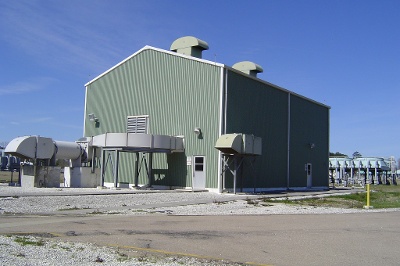 uilding, and that creates a serious engineering challenge: massive combustion and cooling airflow requirements, precise static pressure control, and noise levels that must be brought down to meet local ordinances, all while the equipment runs around the clock in demanding environments.
Eldridge designs and installs the ventilation, airflow, and acoustic systems that keep gas turbine power installations running safely and efficiently — whether it’s a utility-scale plant, an industrial cogeneration unit, or a behind-the-meter turbine dedicated to powering a data center campus. With decades of experience engineering enclosure ventilation for high-heat, high-noise industrial equipment, Eldridge understands the specific demands turbine packages place on a building’s airflow and acoustic design, and delivers systems built to match manufacturer specifications from day one.
Gas Turbines Powering Data Centers
Data center power demand has grown faster than utility grids can build new transmission and interconnection capacity, pushing many operators toward on-site or behind-the-meter gas turbine generation to get power online quickly. Rather than waiting years for a grid interconnection study and utility-scale transmission upgrades, developers are increasingly deploying dedicated gas turbine generation directly at or near the data center site, allowing new compute capacity to come online on a timeline measured in months rather than years.
These installations bring the same enclosure ventilation and noise challenges as utility power plants, but often in tighter footprints and closer to commercial or residential neighbors — making properly engineered airflow and acoustic control even more critical. A behind-the-meter turbine package supporting a hyperscale campus still needs to move enormous volumes of combustion and cooling air, maintain precise static pressure inside its enclosure, and meet noise ordinances at the property line, frequently on a compressed construction schedule driven by the urgency of getting compute capacity online.
Eldridge supports data center gas turbine installations with:
- Enclosure ventilation sized for combustion and cooling air demand
- Static pressure control matched to turbine manufacturer specifications
- Acoustic silencers and enclosure treatments engineered to meet local noise ordinances near commercial and residential zones
- Explosion-proof motors and components where required by the site’s hazard classification
- Rapid-deployment ventilation packages suited to the accelerated timelines typical of data center power projects
- Coordination with turbine OEMs and EPC contractors to ensure ventilation systems are integrated into the overall power package from the design phase forward
As more data center operators pursue on-site generation to solve interconnection bottlenecks, ventilation and acoustic engineering has become a critical path item rather than an afterthought — a turbine that can’t move enough air or meet its noise limits can delay a project just as easily as a delayed utility interconnection.
Engineering Approach: Airflow, Pressure, and Noise
Every gas turbine ventilation system Eldridge designs starts with the same three core requirements, regardless of whether the installation is a utility plant, an industrial facility, or a data center power package.
Airflow volume: The enclosure must supply enough air to meet the turbine’s combustion air requirements and remove waste heat from auxiliary equipment, all without creating excessive pressure drop across intake louvers, filters, and dampers.
Static pressure balance: Supply and exhaust fans are sized and balanced together so the enclosure maintains the pressure differential the turbine manufacturer specifies. Too much negative pressure can starve the intake and reduce turbine performance; too much positive pressure can push hot exhaust gases back into occupied or equipment areas.
Acoustic performance: Turbine enclosures are treated with silencers, absorptive materials, and sometimes secondary enclosures to bring sound levels down to whatever limit applies at the site — a local ordinance, a permit condition, or a company standard, whichever is strictest.
Frequently Asked Questions
Why do gas turbine power plants need special ventilation? A gas turbine generates significant heat and requires a constant, high-volume supply of combustion and cooling air. Without properly engineered ventilation, heat buildup can trigger safety shutdowns, reduce turbine efficiency, or create hazardous conditions inside the enclosure.
How is static pressure managed inside a turbine enclosure? Supply and exhaust fans are balanced to maintain the pressure differential specified by the turbine manufacturer — too much negative pressure can starve the engine’s air intake, while too much positive pressure can force hot exhaust gases back into the enclosure.
Why are gas turbines being used to power data centers? Data center power demand is outpacing available grid capacity and interconnection timelines in many regions. On-site or behind-the-meter gas turbines let operators bring power online faster than waiting for utility grid upgrades, but they require the same enclosure ventilation and noise engineering as any other turbine installation, often on a more compressed schedule.
What noise control is required for gas turbine installations near populated areas? Turbine installations near residential or commercial areas typically must meet local noise ordinances measured at the property line. Eldridge designs acoustic silencers and enclosure treatments engineered to specific decibel targets rather than generic sound dampening.
What equipment is typically installed in a gas turbine ventilation system? Supply and exhaust axial and centrifugal fans, process fans and blowers, explosion-proof motors, intake and exhaust louvers and dampers, gravity ventilators, gas-fired and electric unit heaters, and acoustic silencers and enclosure sound treatments.
How long does it take to design and install a turbine ventilation system? Timelines vary with project scope and site conditions, but Eldridge works closely with turbine OEMs, EPC contractors, and site developers to align ventilation design and installation with the overall project schedule, including expedited timelines common on data center power projects.
Industrial Ventialtion Equipment:
- Fans
- Supply / Exhaust
- Process
- Blowers
- Filters
- Louvers and Dampers
- Gravity Vents
- Gas Fired and Electric Heaters
- Acoustic Silencers