
In the world of industrial engineering, there is no room for “guesstimation.” Whether you are designing a climate control system for a 500,000-square-foot distribution center in Houston or a precision cooling loop, the foundation of your success rests on one critical process: the Heat Load Calculation.
Getting this calculation right is the difference between a facility that operates at peak efficiency and one that suffers from “short-cycling” equipment, astronomical energy bills, and a frustrated workforce.
What is Heat Load?
In simple terms, heat load is the amount of heat energy that must be added to or removed from a space to maintain a specific temperature and humidity level. For engineers, this isn’t just a single number; it is a dynamic sum of various thermal influences.
We categorize these influences into two main types:
- Sensible Heat: Heat that causes a change in temperature (what you feel on the thermometer).
- Latent Heat: Heat associated with moisture and humidity (what you feel as “mugginess”).
In an industrial setting, ignoring the latent heat produced by manufacturing processes or high-traffic bay doors is a recipe for equipment failure.
The Four Pillars of Heat Load Sources
To perform an accurate calculation, an engineer must account for every “BTU” (British Thermal Unit) entering or being generated within the building envelope.
1. External Heat Gains (The Envelope)
This is the heat entering from the outside world. It includes:
- Solar Radiation: Heat from the sun hitting the roof and walls.
- Conduction: Heat moving through building materials (glass, steel, concrete).
- Infiltration: Warm outside air leaking through windows, cracks, and frequently opened loading dock doors.
2. Internal Heat Gains (The Process)
In a warehouse or factory, internal gains often dwarf external gains.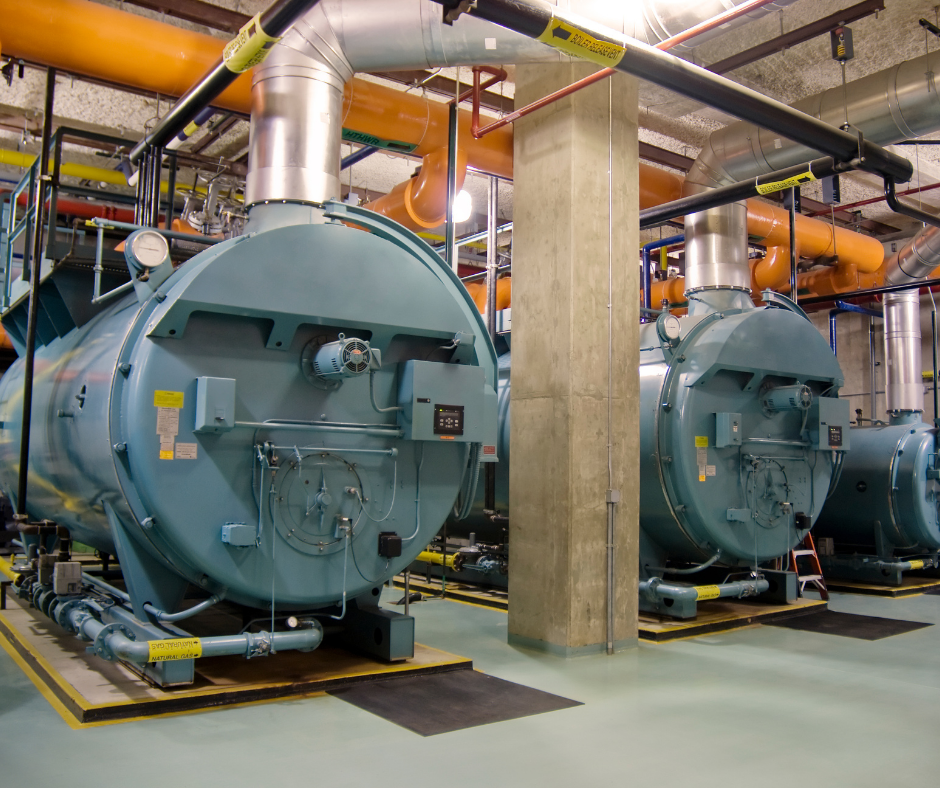
- Lighting: Even LED lights generate some heat, but older HID or fluorescent fixtures are major contributors.
- Machinery & Motors: Every kilowatt of electricity consumed by a motor that isn’t converted into mechanical work is released as heat.
- Boilers & Process Ovens: Unlike motors, these machines are designed to generate high temperatures. Even with heavy insulation, boilers and ovens lose heat through “shell losses” and “convective plumes” when doors are opened or products emerge at several hundred degrees.
- People: A sedentary worker emits about 250–400 BTU/hr, but a laborer moving heavy pallets can emit over 1,000 BTU/hr.
3. Ventilation Loads
OSHA and ASHRAE standards require a specific amount of “makeup air” to ensure indoor air quality. During a Texas summer, bringing in 10,000 CFM of 95°F air adds a massive thermal burden to your cooling system.
4. Product Loads
In cold storage or food processing, you must account for the heat brought in by the product itself. If you move 20 pallets of room-temperature goods into a chilled warehouse, the “sensible heat” of those products must be removed.
How Engineers Calculate Heat Load
While modern software has streamlined the process, every engineer should understand the fundamental physics behind the math.
The Basic Formula for Sensible Heat
To calculate the heat required to cool air, we use:
Qs=1.08×CFM×ΔT
Where:
- Qs = Sensible heat (BTU/hr)
- CFM = Airflow in Cubic Feet per Minute
- ΔT = Temperature difference between the outside air and the desired indoor setpoint.
The Basic Formula for Latent Heat
To account for moisture removal (dehumidification):
Ql=0.68×CFM×ΔW
Where:
- Ql = Latent heat (BTU/hr)
- ΔW = Difference in humidity ratio (grains of moisture per pound of dry air).
The “U-Value” and “R-Value”
When calculating conduction through walls, engineers look at the U-value (thermal transmittance). The lower the U-value, the better the insulation.
Q=U×A×ΔT
(Where A is the surface area of the wall or roof).
Why “Bigger” Isn’t Better: The Dangers of Oversizing
A common mistake in industrial facility management is the “safety margin” trap. If the calculation calls for a 40-ton unit, the thinking goes, “Let’s install a 60-ton unit just to be safe.” This is a critical error.
The Short-Cycling Nightmare
When a system is oversized, it reaches the target temperature too quickly and shuts off. This is called short-cycling.
- Humidity Issues: It takes time for cooling coils to get cold enough to remove moisture. If the unit only runs for five minutes, it cools the air but leaves the humidity behind, resulting in a “cold and clammy” environment.
- Mechanical Wear: The most stressful moment for a compressor is the startup. Frequent starts and stops lead to premature motor failure.
- Energy Waste: Motors are least efficient during the “inrush” period of startup. Oversized units spike your peak demand charges on your utility bill.
The Benefits of Proper Heat Load Calculations
When an engineer takes the time to perform a rigorous heat load analysis, the benefits ripple throughout the entire organization.
1. Optimized Capital Expenditure
Accurate math allows you to buy exactly the equipment you need. You aren’t wasting money on “extra tons” of cooling that you will never use.
2. Improved Process Stability
In industries like commercial printing or plastic injection molding, slight fluctuations in temperature can cause materials to expand or contract, leading to “out-of-spec” products. A correctly sized system maintains a flat-line temperature graph.
3. Worker Productivity and Safety
Heat stress is a leading cause of workplace accidents and reduced cognitive function. By properly calculating the load—especially the radiant heat from machinery—you ensure that the “Effective Temperature” at the workstation remains within the ASHRAE comfort envelope.
Modern Tools and the Future of Heat Load Calculations
We are moving past static calculations toward Dynamic Building Simulation.
- BIM (Building Information Modeling): Tools like Revit allow engineers to pull thermal data directly from the architectural model.
- CFD (Computational Fluid Dynamics): For complex factories with “hot spots,” CFD modeling shows exactly how air moves around equipment, ensuring that the cooling actually reaches the floor instead of getting trapped in the ceiling joists.
Engineering the Ideal Environment
A heat load calculation is more than just a box to check during the design phase; it is a vital document that dictates the operational health of your facility for the next 20 years. By understanding the balance of sensible and latent loads, and resisting the urge to over-engineer through “brute force” sizing, engineers can create systems that are lean, efficient, and reliable.
At the end of the day, we aren’t just moving BTUs—we are protecting the equipment, the product, and the people that keep the world moving. today to learn more about our industrial ventilation design process.