
Industrial ventilation design is about much more than moving air from one place to another. Effective ventilation systems must control temperature, humidity, air quality, and pressure relationships while maintaining worker comfort, protecting products, and ensuring process reliability. One of the most important tools engineers use to achieve these goals is the psychrometric chart.
Although modern software can automate many HVAC and ventilation calculations, understanding psychrometrics remains fundamental to designing high-performance industrial ventilation systems. At Eldridge, psychrometric analysis is a critical part of evaluating heat loads, humidity control requirements, airflow rates, and overall facility performance.
What Is a Psychrometric Chart?
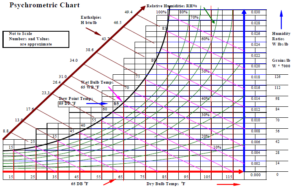
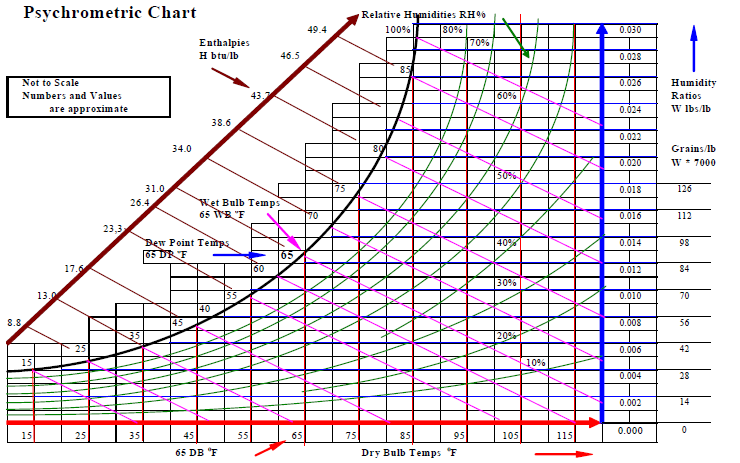
A psychrometric chart is a graphical representation of the thermodynamic properties of air and water vapor mixtures. In simple terms, it shows how temperature, humidity, energy content, and air density relate to one another.
Engineers use psychrometric charts to analyze air conditions and predict how air will behave as it is heated, cooled, humidified, dehumidified, or mixed with other air streams.
The chart allows a designer to determine several important air properties, including:
- Dry-bulb temperature
- Wet-bulb temperature
- Relative humidity
- Dew point temperature
- Humidity ratio
- Specific volume
- Enthalpy (total heat content)
By identifying any two known air conditions, an engineer can locate a point on the chart and determine all other properties of the air.
Understanding the Key Components
Dry-Bulb Temperature
Dry-bulb temperature is the temperature most people are familiar with. It is measured using a standard thermometer and appears along the horizontal axis of the psychrometric chart.
In industrial facilities, dry-bulb temperature affects worker comfort, equipment performance, and product quality.
Relative Humidity
Relative humidity (RH) indicates how much moisture is present in the air compared to the maximum amount the air can hold at a given temperature.
High humidity can lead to:
- Condensation
- Corrosion
- Mold growth
- Product degradation
- Employee discomfort
Low humidity can create static electricity issues and negatively impact certain manufacturing processes.
Humidity Ratio
Humidity ratio measures the actual amount of water vapor in the air. This value is especially important for industrial applications because it allows engineers to calculate moisture loads and dehumidification requirements.
Dew Point Temperature
Dew point is the temperature at which moisture begins to condense from the air.
In industrial environments, controlling dew point is critical for preventing:
- Ice formation in cold storage facilities
- Condensation on equipment
- Corrosion
- Moisture damage to products
Enthalpy
Enthalpy represents the total heat content of the air, including both sensible heat and latent heat.
Ventilation engineers use enthalpy to determine cooling loads, heating loads, and energy requirements for air treatment systems.
Why Psychrometrics Matters in Industrial Ventilation
Industrial ventilation systems must do more than provide fresh air. They often need to remove heat, control humidity, capture contaminants, and maintain pressure relationships throughout a facility.
Psychrometric analysis provides the foundation for these calculations.
For example, when outside air enters a manufacturing facility, it brings both heat and moisture with it. The ventilation system must account for these loads before conditioned air reaches workers or production areas.
By using a psychrometric chart, engineers can determine:
- How much moisture enters the building
- How much heat must be removed
- Required airflow rates
- Dehumidification requirements
- Energy consumption impacts
Without psychrometric analysis, ventilation systems are often oversized, undersized, or inefficient.
Common Industrial Applications
Humidity Control
Humidity control is often one of the most challenging aspects of industrial ventilation design.
Excess moisture can damage products, create safety hazards, and reduce productivity. Facilities such as food processing plants, pharmaceutical manufacturers, and cold storage warehouses require precise humidity management.
Psychrometric analysis allows engineers to calculate exactly how much moisture must be removed or added to maintain target conditions.
Cold Storage Facilities
One of the most practical applications of psychrometrics is cold storage design.
When warm, humid outdoor air enters a refrigerated environment, moisture can condense and freeze on surfaces. This can create operational problems, safety concerns, and product quality issues.
Psychrometric analysis enables engineers to determine moisture infiltration rates and properly size dehumidification equipment. By understanding humidity ratios, dew points, and airflow requirements, designers can prevent ice buildup and maintain optimal storage conditions.
Air Change Rate Optimization
Industrial facilities often require specific air change rates to remove contaminants, fumes, heat, or airborne particles.
Psychrometric calculations help determine whether outdoor air alone can achieve desired environmental conditions or whether additional cooling, heating, or dehumidification equipment is required.
The Relationship Between Airflow Measurement and Psychrometrics
Psychrometric calculations are only as accurate as the airflow data used in the analysis.
This is why airflow measurement plays such a critical role in industrial ventilation design.
Engineers must know exactly how much air is moving through a system to calculate:
- Heat removal rates
- Moisture removal rates
- Ventilation effectiveness
- Energy consumption
- System performance
Accurate thermal mass flow measurement technology provides the reliable airflow data necessary to validate psychrometric calculations and ensure ventilation systems perform as designed.
When airflow measurements are inaccurate, even the most sophisticated psychrometric analysis can produce misleading results.
How Eldridge Applies Psychrometrics
Eldridge integrates psychrometric analysis into every stage of industrial ventilation design.
The company’s engineering team performs detailed evaluations that include:
- Heat load calculations
- Humidity assessments
- Airflow analysis
- Fluid flow modeling
- Ventilation system design
- Equipment specification
By combining psychrometric principles with advanced ventilation engineering, Eldridge helps customers create successful environments for people, products, and processes.
Whether designing a facility-wide ventilation system, solving humidity problems in a cold storage warehouse, or optimizing airflow performance in a manufacturing plant, psychrometric analysis provides the scientific foundation for informed engineering decisions.
Conclusion
The psychrometric chart remains one of the most powerful tools in industrial ventilation engineering. It transforms complex relationships between temperature, humidity, airflow, and energy into actionable information that engineers can use to design effective systems.
Understanding psychrometrics enables facility owners and engineers to make better decisions about heat removal, humidity control, energy efficiency, and indoor air quality. More importantly, it ensures that ventilation systems support worker safety, product integrity, and operational performance.
At Eldridge, psychrometric analysis is not simply a calculation—it’s a critical component of delivering ventilation solutions that solve real-world industrial challenges. By combining decades of ventilation expertise with accurate airflow measurement and advanced engineering analysis, Eldridge helps facilities achieve optimal environmental control and long-term operational success.