
Industrial fans are used in industries such as manufacturing plants, warehouses, HVAC systems, data centers, and processing facilities. They move air for cooling, ventilation, dust extraction, heat removal, and countless industrial processes. Because they are so common, fans are often treated as simple components—select one that seems powerful enough, install it, and move on.
In reality, this approach causes a surprising number of performance, reliability, and energy-efficiency problems. The performance of any fan depends not only on the fan itself, but on how it interacts with the system it is installed in. This relationship is described by the fan curve, also known as the fan performance curve.
Ignoring the fan curve during industrial fan selection is not a small technical oversight. It can quietly undermine airflow performance, increase operating costs, and shorten the life of expensive equipment. Over time, these issues show up as higher energy bills, more downtime, and unpredictable system behavior.
What Is a Fan Curve?
A fan curve is a performance graph that shows how a fan behaves at different airflow and pressure conditions. It illustrates how much air the fan can move as system resistance changes, and it also shows how power consumption and efficiency vary across that range.
Every real system has resistance. Ductwork, filters, heat exchangers, silencers, and grilles all restrict airflow. The fan does not operate at a single fixed point; instead, it settles at the point where its performance curve intersects the system’s resistance curve. This point is the true operating condition of the fan.
Without using the fan curve, you never really know how much air the fan will deliver, how much energy it will consume, or whether it will operate in a stable and efficient region.
The Most Common Problem: Getting the Wrong Airflow
One of the most widespread mistakes in industrial ventilation and cooling systems is assuming that a larger or more powerful fan automatically means more airflow. However, this is not always true. If the system resistance is higher than expected, even a large fan may deliver far less air than required.
When the fan curve is ignored, it is easy to end up with a fan that simply cannot overcome the real pressure losses of the system. The result is insufficient airflow, even though the fan is running at full speed. This can lead to overheated equipment, poor fume or dust extraction, and underperforming heat exchangers or cooling systems.
The opposite problem is also common. Sometimes the selected fan delivers far more airflow than needed. This creates unnecessary noise, higher energy consumption, and excessive air velocities that can damage ducts or interfere with the process itself.
Higher Energy Costs That Never Go Away
Industrial fans often run for thousands of hours per year and can be among the largest consumers of electricity in a facility. Small inefficiencies in fan selection,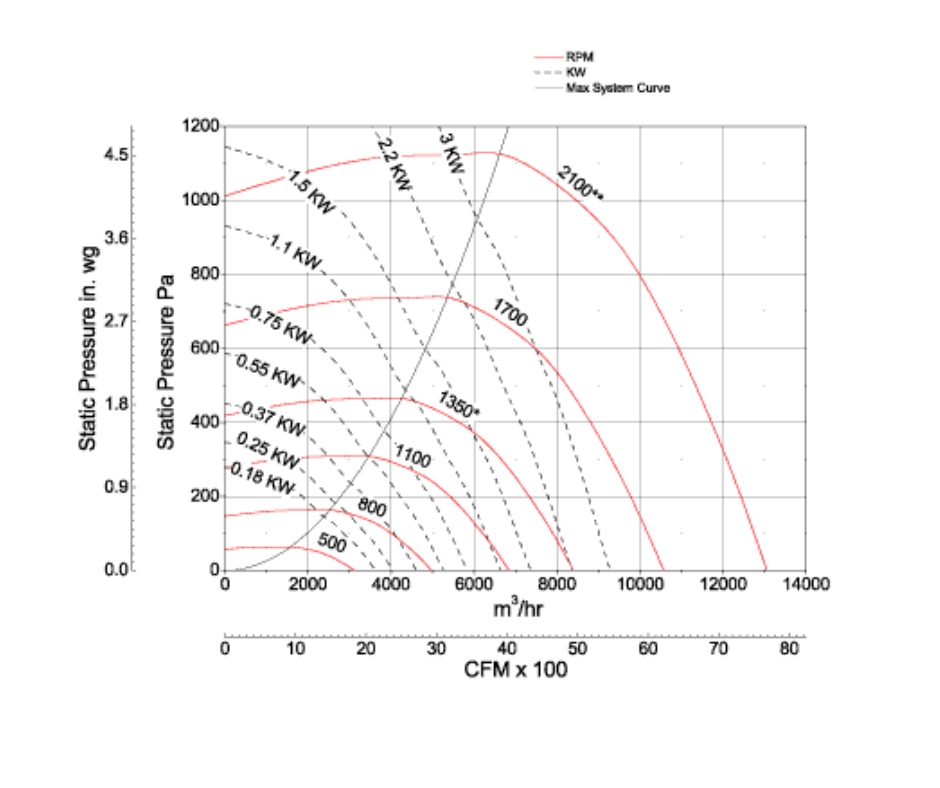 therefore, turn into very large operating costs over time.
When a fan is selected without using its performance curve, it frequently ends up operating far away from its best efficiency point. In that region, the fan may consume significantly more power than necessary for the same useful airflow. The system still “works,” so the problem may go unnoticed, but the energy waste continues every hour the fan is running.
Over the lifetime of the equipment, this can easily cost many times more than the fan itself. Using the fan curve during design is one of the simplest and most effective ways to control long-term energy consumption.
Noise, Vibration, and Unstable Operation
Not all points on a fan’s performance curve represent stable operation. Many fans have regions where airflow and pressure fluctuate, leading to surging, pulsation, or strong vibration. These effects are not only annoying but also mechanically destructive.
If a system is designed without checking the fan curve, it may end up operating precisely in one of these unstable regions. The fan may seem fine at first, but over time, the vibration and fluctuating loads accelerate wear and stress on bearings, shafts, blades, and supports. Noise levels increase, and structural problems in ductwork or mounting frames become more likely.
The fan curve makes these unstable regions visible. Ignoring it means discovering them the hard way.
The Hidden Risk of Motor Overload
Another critical piece of information shown on a fan curve is power consumption. Depending on where the fan operates, the required shaft power can change significantly.
If this is not checked, it is entirely possible to select a fan that draws more power at the actual operating point than the motor is rated to handle. Sometimes this problem only appears later, after a system change such as a filter replacement, a duct modification, or a damper adjustment.
When a motor is overloaded, it runs hotter, its insulation ages faster, and its protection devices may trip frequently—or fail to trip in time. Eventually, this leads to motor failure, unplanned downtime, and repair costs that could have been avoided with proper fan curve analysis.
Shorter Equipment Life and Higher Maintenance
Fans that operate outside their intended range are under constant mechanical stress. Bearings experience higher loads, shafts see more fatigue cycles, and impellers may flex or vibrate more than they should. Even if nothing fails immediately, the cumulative effect is a shorter service life and more frequent maintenance interventions.
From a maintenance perspective, these systems often feel “unlucky.” Components seem to wear out faster than expected, and failures appear random. In reality, the root cause is often that the fan was never operating in a healthy region of its performance curve.
Loss of Process Control and Consistency
In many industrial applications, airflow is not just a support function. It is a critical part of the process itself. Drying, curing, combustion air supply, cleanroom pressure control, fume extraction, and material conveying all depend on predictable and stable airflow.
When the fan is not selected using its curve, the actual airflow is often unknown or poorly controlled. This leads to inconsistent process conditions, variable product quality, and constant manual adjustments by operators who are trying to compensate for a system that was never properly engineered.
Why System Changes Become So Risky
No industrial system stays exactly the same forever. Filters clog, ductwork gets extended, machines are added, and layouts evolve. If the fan was never selected using proper performance analysis, there is no clear understanding of how much margin the system had to begin with.
A seemingly small change can push the fan into an inefficient, unstable, or overloaded operating region. When the original design was done using fan curves, these effects can be predicted and managed. Without them, every modification becomes a gamble.
The Fan Curve Is Not Optional
In industrial applications, the fan curve is not an academic detail or an optional engineering step. It is a fundamental tool for ensuring that a system delivers the right airflow, uses energy efficiently, and operates reliably for years.
If you don’t use a fan curve, you are not really designing a system—you are guessing. Sometimes that guess appears to work, but over time the hidden costs show up in the form of higher energy bills, more failures, and reduced process reliability.
Using fan curves turns ventilation and cooling systems from trial-and-error installations into properly engineered, predictable, and cost-effective industrial assets.