
Ventilation is a critical part of industrial infrastructure. Whether you run a chemical plant, wastewater treatment facility, food processing plant, or manufacturing shop, keeping the air clean — removing moisture, fumes, dust, and contaminants — is essential not only for equipment longevity but for worker safety, process quality, and regulatory compliance. The heart of many ventilation systems is the industrial fan. As well as the material and design of that fan play a huge role in performance and durability.
Traditionally, industrial fans have been made from metal (steel, stainless steel, aluminum). But in many demanding environments, metal fans face challenges. These include: corrosion from chemicals or moisture, rust from humidity or salt air, oxidation from acidic fumes, structural wear over time from vibration or stress. Over time, these can degrade airflow performance, increase maintenance costs, and even pose safety risks.
That’s where fiberglass fans — or fiberglass-reinforced plastic (FRP) — come in. Instead of relying on metal, FRP fans use composite materials (fiberglass + resin) that offer a compelling alternative, especially in harsh industrial environments.
What Are Fiberglass / FRP Fans?
Fiberglass fans are ventilation fans whose housings, impellers (fan blades), and exposed components are built with fiberglass-reinforced plastic (FRP), often using high-grade resins (e.g. vinyl ester) to ensure chemical resistance and structural integrity.
Depending on the application, fiberglass fans can be built in many configurations. Centrifugal, tube-axial, wall-box, hooded axial, roof-mounted, and more are just some of the different fan types.
In many FRP fans, internal metal parts (shafts, hubs, bolts) that might be exposed to air stream are encapsulated or coated to prevent corrosion, and the fiberglass surfaces are veil-coated to avoid exposed glass fibers that could wick moisture or chemicals. This helps ensure a fully corrosion-resistant airstream environment.
Because of the composite nature and molding processes, many fiberglass fan wheels are “one-piece” designs — avoiding joints or seams that could become weak points under stress or vibration — which enhances durability and lifespan.
A major reason fiberglass fans are widely used is their superior chemical resistance. In certain industries, air streams may contain corrosive components like chlorine, sulfuric acid vapor, hydrogen sulfide, or caustic compounds. FRP materials stand up well to these substances, maintaining structural integrity and performance over long periods. This makes fiberglass fans a highly cost-effective solution for harsh environments where longevity and reliability are essential.
The Key Advantages of Fiberglass Fans
Corrosion, Chemical & Moisture Resistance
As mentioned before, probably the most important advantage is corrosion resistance. Fiberglass fans are inherently non-reactive to a wide range of chemicals — acids, alkalis, solvents — and resist corrosion from moisture, humidity, salt, and industrial fumes.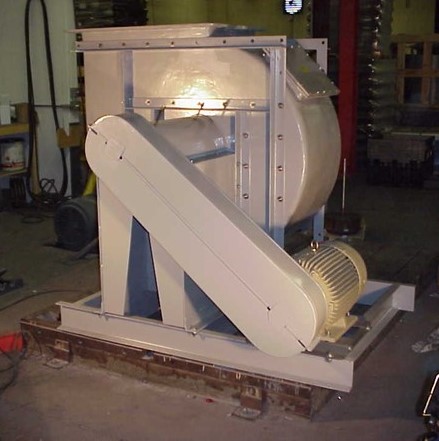
In environments like chemical processing, wastewater treatment, metal plating, paper mills, marine or coastal settings, or any application with aggressive gases or moisture, fiberglass fans maintain structural integrity much longer than metal fans.
Moreover, because the corrosion-resistant properties come from the entire composite structure (not just a coating), there’s no risk of pinhole faults or coating wear exposing bare metal — a common weakness in coated-metal fans.
Longevity & Low Maintenance
Due to their resistance to chemical attack, corrosion, moisture, and mechanical stress, fiberglass fans typically have much longer lifespans than metal fans in harsh environments. Some sources note that their durability can surpass that of stainless steel or special-alloy fans.
The composite construction also reduces the risk of fatigue failure caused by vibration, and because fiberglass doesn’t corrode, dust and chemical build-up are less likely to degrade the structure over time.
Safety — Non-Sparking, Spark-Resistant, Fire-Retardant
In settings where combustible dust, flammable vapors, or explosive gases may be present (e.g., chemical plants, grain-handling facilities, paint booths, refineries), the non-ferrous nature of FRP fans is a major safety benefit. Fiberglass fans are often “spark-resistant” (meet spark-resistance standards) because they lack metallic, conductive parts exposed to the airstream.
Moreover, many FRP fans are manufactured with fire-retardant resins (e.g., vinyl ester) and coatings to ensure that even in the case of ignition, the material does not easily propagate flames — a critical factor for industrial safety.
Where Fiberglass Fans Excel — Typical Applications
Because of their unique advantages, fiberglass fans are well-suited for environments where traditional metal fans would struggle or require frequent maintenance. Some common and ideal applications include:
- Chemical processing plants — acids, solvents, caustic chemicals, corrosive gases. FRP fans resist these conditions much better than metals.
- Wastewater treatment facilities — corrosive water vapor, chlorinated gases, humidity: fiberglass handles these without rust or corrosion.
- Pulp and paper mills, bleach plants, metal finishing/plating – all environments with corrosive chemicals, fumes, and often moisture.
- Cooling towers, HVAC systems in humid climates, greenhouses, agricultural buildings – high moisture, dust, sometimes chemical residues (fertilizers), benefit from fiberglass fans’ resilience.
- Cleanrooms, laboratories, electronics manufacturing, pharmaceutical facilities — where chemical inertness, predictable airflow, and minimal contamination or particulate generation are essential. Fiberglass doesn’t rust or shed particles like corroded metal might.
Design Flexibility & Types of Fiberglass Fans
One of the hallmarks of fiberglass fan technology is flexibility. Because the impeller, housing, and airflow paths can be molded in composite form, manufacturers can design fans tailored to specific pressure, flow, and environmental requirements.
Common types of FRP industrial fans include:
- Backward-inclined centrifugal fans — high-pressure, efficient airflow; good for ducted or long-distance exhaust.
- Radial-blade centrifugal fans — robust and rugged for dust-laden or abrasive airstreams.
- Inline centrifugal fans — compact form-factor, useful in tight ducting or constrained spaces.
- Axial (tube-axial) fans, wall-box fans, hooded axial fans — for situations needing high volume, low-pressure airflow (ventilation, cooling, exhaust of large spaces).
- Upblast/downblast roof exhausters, wall exhausters — for venting fumes and moist air from rooftops or exterior walls, especially in industrial buildings.
This variety allows engineers and facility managers to pick a fan type well-suited to their duct design, airflow requirements, static pressure, and environmental conditions — while still reaping the benefits of FRP.
Why Many Companies Are Shifting to Fiberglass / FRP Fans
Recent industry trends show increasing adoption of fiberglass fans — particularly in sectors dealing with corrosive, moist, or chemically aggressive environments.
For industries that value reliability, low maintenance, long service life, and safety (chemical processing, wastewater treatment, agriculture, food processing, painting/coating facilities, HVAC retrofit projects), FRP fans offer a cost-effective long-term solution.
Because they reduce downtime, maintenance costs, and risk of corrosion-related failures — and because they can be designed to meet spark-resistant and fire-retardant standards — they’re often the preferred ventilation solution, especially in regulated or hazardous industries.
Practical Guidance: When to Choose Fiberglass Fans
If you are specifying or designing a ventilation system for an industrial or commercial facility, here are some practical guidelines for when to choose FRP / fiberglass fans:
- Environment includes corrosive gases, fumes, chemicals, or high humidity — e.g. chemical processing, wastewater, plating, pulp & paper, marine/coastal, salt-laden air.
- Need for corrosion resistance over long lifetimes — especially when maintenance access is difficult, downtime is costly, or reliability is critical.
- Need for spark-resistance or fire-retardant ventilation — in dusty, flammable, or combustible environments (grain handling, paint booths, solvent vapors, petrochemical applications).
- Desire for lower long-term maintenance and operating cost — despite possibly higher upfront cost, savings over time in repairs and downtime.
- Need for flexibility of fan type and configuration — when a variety of fan shapes are required.
If you meet several of the above criteria, fiberglass fans are often the best investment.
Conclusion — Fiberglass Fans: Durable, Smart Ventilation
In many industrial and commercial settings, ventilation is a critical enabler — for safety, process integrity, environmental compliance, and worker health. The fan you choose can make a fundamental difference to the performance and longevity of your system.
Fiberglass (FRP) fans deliver a set of advantages. These advantages include corrosion and chemical resistance, moisture resistance, lower maintenance, safety, and flexibility in design. For demanding environments that combine moisture, chemicals, or risk of corrosion, fiberglass fans often outperform traditional metal units and yield lower total cost of ownership over time.
Selecting the right fan means carefully considering the airstream environment, pressure requirements, maintenance expectations, structural constraints, and safety demands. A well-specified FRP fan — with the right impeller type, resin/veil configuration, balanced motor, and proper installation — can provide decades of reliable performance where metal fans would degrade in months or years.
For those managing industrial ventilation systems, fiberglass fans represent not just an alternative, but often the superior choice. Contact one of our experts at Eldridge to learn more about our Fiberglass Fans.