
Industrial ventilation system design requires more than selecting fans and determining how much air needs to move through a building. Engineers must also understand how temperature, humidity, moisture content, and heat interact to create the right indoor environment.
A psychrometric chart is one of the most useful engineering tools for evaluating these conditions. It allows ventilation engineers to analyze the properties of air, identify heating and cooling requirements, calculate moisture loads, and determine which equipment is needed to maintain desired environmental conditions.
How are psychrometric charts used in industrial ventilation design? Engineers use psychrometric charts to compare existing air conditions with desired conditions, evaluate the effects of outdoor air, calculate heating and cooling loads, and determine whether equipment such as industrial fans, cooling coils, evaporative coolers, or dehumidifiers is needed.
At Eldridge, psychrometric analysis is an important part of developing effective industrial ventilation solutions. By combining heat load evaluations, airflow analysis, and fluid flow modeling, engineers can develop ventilation systems that address the specific environmental challenges of each facility.
What Is the Purpose of a Psychrometric Chart in Ventilation Design?
A psychrometric chart is a graphical representation of the thermodynamic properties of air and water vapor. It shows how different air properties relate to one another under a specific atmospheric pressure.
In industrial ventilation engineering, the chart helps determine how air will behave when it is heated, cooled, humidified, dehumidified, or mixed with another air stream.
Rather than evaluating temperature or humidity independently, engineers can examine how changes in one property affect the others.
For example, introducing hot, humid outdoor air into a manufacturing facility increases both the sensible heat load and the moisture load. A psychrometric chart helps engineers understand the amount of conditioning required before that air can meet the facility’s environmental requirements.
This information supports decisions about:
- Industrial ventilation equipment selection
- Heating and cooling requirements
- Dehumidification capacity
- Outdoor air intake requirements
- Energy consumption
- Indoor temperature and humidity control
Psychrometric analysis is especially valuable in facilities where environmental conditions directly affect employees, equipment, products, or manufacturing processes.
Understanding the Measurements Used in a Psychrometric Chart
Before using a psychrometric chart for ventilation system design, engineers must understand the air properties represented on the graph.
Each measurement provides different information about the condition and behavior of air.
1. Dry-Bulb Temperature
Dry-bulb temperature is the standard air temperature measured using a conventional thermometer. It is represented along the horizontal axis of a psychrometric chart.
In industrial environments, dry-bulb temperature helps engineers evaluate heat buildup, determine cooling requirements, and assess employee working conditions.
2. Wet-Bulb Temperature
Wet-bulb temperature measures the combined effect of air temperature and moisture through evaporative cooling.
This measurement is particularly important when evaluating evaporative cooling systems. It helps engineers estimate how effectively a system can cool incoming air through water evaporation.
3. Relative Humidity
Relative humidity (RH) describes how close the air is to saturation at a given temperature.
High relative humidity can contribute to condensation, corrosion, mold growth, and moisture-related product damage. Low relative humidity can create static electricity concerns and affect certain manufacturing processes.
4. Humidity Ratio
Humidity ratio measures the mass of water vapor relative to the mass of dry air.
This measurement is particularly useful when calculating how much moisture must be removed or added to an industrial environment.
Unlike relative humidity, humidity ratio provides a direct measurement of the moisture content of the air.
5. Dew Point Temperature
Dew point is the temperature at which air becomes saturated and water vapor begins condensing into liquid water when the air is cooled.
Understanding dew point is important in industrial facilities where condensation can damage equipment, affect products, or create operational problems.
6. Enthalpy
Enthalpy represents the total heat content of moist air, including sensible heat and latent heat.
Engineers use enthalpy to evaluate heating and cooling processes and estimate the energy required to change air conditions.
Together, these measurements provide the information necessary to evaluate an industrial facility’s air conditions and determine the appropriate ventilation strategy.
How Do Engineers Read a Psychrometric Chart?
A psychrometric chart may initially look complicated because it contains multiple intersecting lines, curves, and measurements. However, understanding its basic layout makes it much easier to interpret.
The horizontal axis represents dry-bulb temperature, while the vertical axis represents humidity ratio, or the actual moisture content of the air.
Additional lines represent other air properties:
 Curved lines represent relative humidity.
- Diagonal lines represent wet-bulb temperature and approximately constant enthalpy.
- The upper curved boundary represents saturation, where relative humidity reaches 100%.
- Dew point can be determined by following a constant humidity-ratio line toward the saturation curve.
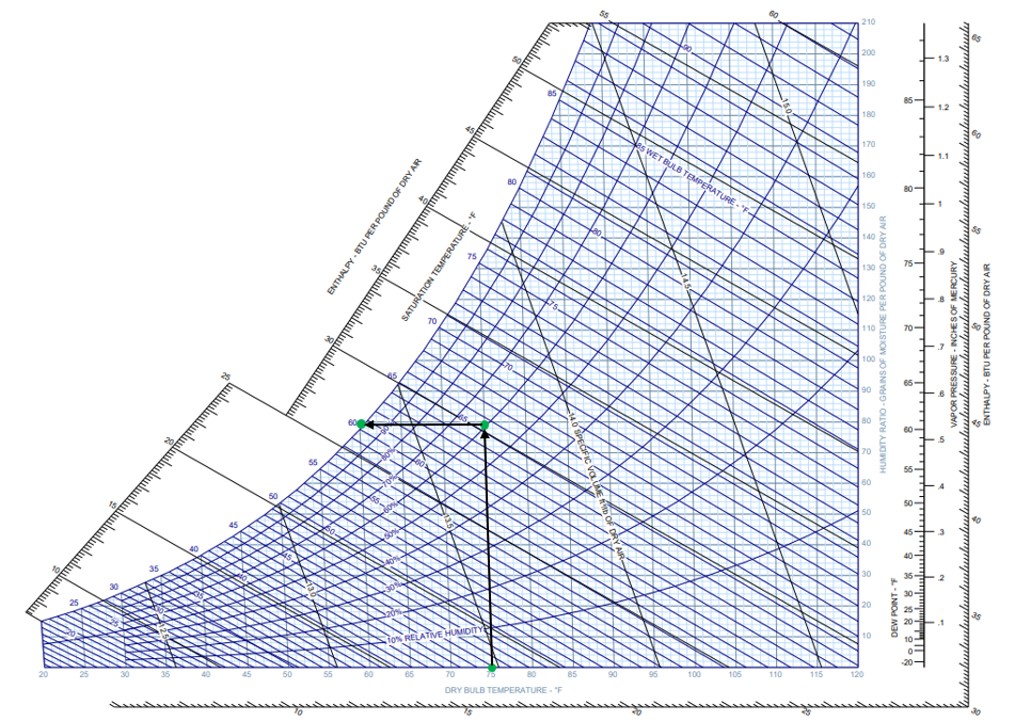
To use the chart, engineers begin with two known air properties, such as dry-bulb temperature and relative humidity. These values identify a point on the chart.
Once the point is established, other air properties can be determined, including humidity ratio, wet-bulb temperature, dew point, and enthalpy.
An important consideration: Psychrometric charts are based on atmospheric pressure. Engineers must use the appropriate chart for the facility’s elevation and operating conditions to obtain accurate results.
Why Airflow Measurements Matter in Psychrometric Analysis
Psychrometric calculations are only one part of effective industrial ventilation design. Engineers must also understand how much air is actually moving through the system.
Accurate airflow measurements are necessary to determine heating and cooling loads, evaluate ventilation performance, and verify that equipment is operating as intended.
For example, knowing the temperature and humidity of incoming air is not enough to calculate the total heat or moisture load entering a building. Engineers must also account for the volume or mass flow rate of that air.
This is why airflow analysis and psychrometric calculations must work together.
At Eldridge, ventilation system design incorporates technical evaluations such as:
- On-site ventilation surveys
- Heat load evaluations
- Fluid flow analysis
- Airflow assessments
- System design and equipment specification
- Project management and installation support
Eldridge also uses proprietary Fluid Flow Analysis software to evaluate fan performance and model how ventilation equipment will operate within a system.
Combining these engineering methods helps reduce guesswork during equipment selection and supports more effective ventilation system performance.
How Eldridge Uses Psychrometric Analysis for Industrial Ventilation Design
At Eldridge, successful industrial ventilation design begins with understanding the facility’s specific challenges.
A system designed for a manufacturing plant may have very different requirements from one serving a food processing facility, cold storage warehouse, or power generation operation.
Psychrometric analysis helps establish the environmental requirements, while heat load evaluations and fluid flow modeling provide additional information needed to develop an effective solution.
Depending on the project, Eldridge can evaluate and specify equipment such as:
- Industrial axial and centrifugal fans: Move supply and exhaust air throughout industrial facilities.
- Dehumidifiers: Help control moisture levels in environments with specific humidity requirements.
- Cooling coils: Remove sensible and latent heat from air streams.
- Evaporative cooling units: Reduce incoming air temperatures through evaporation.
- Dampers and louvers: Help regulate and control airflow throughout a ventilation system.
Eldridge provides industrial ventilation design services that include on-site surveys, heat load evaluations, fluid flow analysis, equipment specification, and project management.
By evaluating the entire ventilation system rather than focusing on individual pieces of equipment, Eldridge helps facilities develop solutions that support operational efficiency, environmental control, and long-term performance.
Frequently Asked Questions About Psychrometric Charts and Industrial Ventilation
What is a psychrometric chart used for in HVAC and industrial ventilation?
A psychrometric chart is used to analyze the relationship between air temperature, humidity, moisture content, and heat energy. Engineers use it to evaluate heating, cooling, humidification, dehumidification, and air-mixing processes when designing ventilation and air conditioning systems.
How do psychrometric charts help determine cooling requirements?
Engineers compare the existing air condition with the desired condition on the chart. The difference in enthalpy and the airflow rate help determine the cooling load associated with conditioning that air stream.
Can a psychrometric chart help determine dehumidification requirements?
Yes. Psychrometric charts help engineers identify the moisture content of air and calculate how much moisture must be removed to reach a desired humidity ratio. This information helps determine dehumidification requirements and equipment capacity.
Why is dew point important in industrial ventilation design?
Dew point helps engineers identify when moisture may condense on surfaces or equipment. Understanding dew point is important in cold storage, manufacturing, food processing, and other industrial environments where excess moisture can damage products or equipment.
What is the difference between relative humidity and humidity ratio?
Relative humidity measures how close air is to saturation at a given temperature. Humidity ratio measures the actual mass of water vapor per unit mass of dry air. Humidity ratio is especially useful for calculating moisture loads and dehumidification requirements.
Do psychrometric charts help with evaporative cooling system design?
Yes. Engineers use wet-bulb temperature and other air properties to estimate the cooling potential of evaporative cooling systems. This helps determine whether evaporative cooling is suitable for the facility’s operating conditions.
Does industrial ventilation design require more than psychrometric analysis?
Yes. Psychrometric analysis evaluates the thermal and moisture properties of air, but complete industrial ventilation design also requires airflow calculations, heat load evaluations, fluid flow analysis, equipment selection, and consideration of applicable safety and ventilation requirements.
Need Help Designing an Industrial Ventilation System?
Understanding the relationship between temperature, humidity, airflow, and heat is essential to designing an effective industrial ventilation system.
Psychrometric charts provide engineers with the information needed to evaluate air conditions and determine the appropriate heating, cooling, and moisture control strategies. When combined with accurate airflow measurements and fluid flow analysis, this information supports better equipment selection and more effective system design.
At Eldridge, our team works with industrial facilities to evaluate ventilation challenges and develop solutions tailored to their operational requirements.
Looking to improve airflow, manage heat loads, or control humidity in your facility? Contact Eldridge to discuss your industrial ventilation needs and request a site evaluation.