
Any type of ventilation project for an explosive environment requires specialized skills to understand the requirements of the application and then to select or design the explosion proof equipment to provide the desired results. When the requirement is to heat an explosive environment, there is an even greater skill level required because now we must add a potential ignition source to the environment. In this week’s blog, I’ll discuss how Eldridge solved the problem of heating an explosive environment.
The Environment
Our customer manufactures a variety of corrosion control products. Several of their products are made of fiberglass and it must be properly cured to achieve the desired strength. Although the customer is in Houston, there were a significant number of winter days where the temperature fell below the temperature needed to cure the product. When they searched for heating options, they had to consider the explosive fumes that the fiberglass released while curing. Because they couldn’t find the right solution for the explosive environment, they had to stop production during the cold periods.
Analyzing the Application
The customer’s management was frustrated by the lost productivity during cold periods. When our salesman, Clayton Settle, called on them, they were more than happy to discuss the problem. What they wanted for the fiberglass curing process was to maintain a minimum of 65 degrees F. However, the curing area was not isolated so the entire facility would need to be heated to that temperature.
The facility’s ventilation system was designed with supply and exhaust fans to provide seven air changes per hour. That provided adequate air flow to dilute and remove the fiberglass fumes. However, the high volume of air turnover would make it very difficult to use any type of recirculating heating system.
The Solution
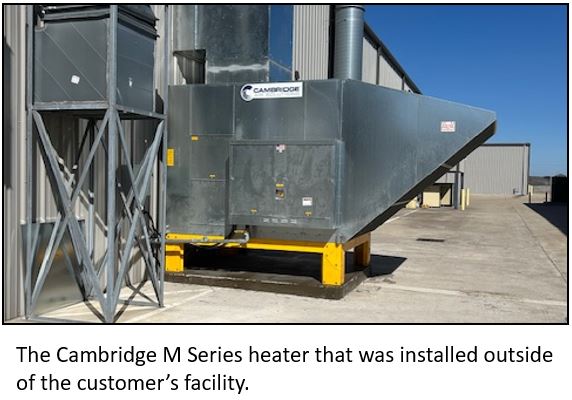 Based on what we learned about the environment and the application, we determined that a one pass heating system located on the outside of the facility would solve the problem. We consulted with our partner for heating equipment, Cambridge Air Solutions. They helped us size their Series M direct gas fired make up air heater. The heater would have to provide the full seven air changes per hour required to maintain air quality and provide sufficient heat to maintain 65 degrees F inside the facility when the outside temperature was as low as 27 degrees F.
Although the heater itself would be outside of the facility, the heater control panel would need to be located inside. For that, we had Cambridge specify an explosion proof control panel. Another concern was air flowing back through the heater when the heater fan was not running. We selected a back draft damper to prevent air backflow. For additional protection, Cambridge programed the fan to run for 10 seconds before the heating element turned on.
Conclusion
The customer was very pleased with the outcome. Because they were able to gain back the production that was lost when it was cold, the payback time for the Cambridge M Series heater was very short.
At Eldridge, our ventilation experts are skilled at solving the toughest ventilation problems, like heating an explosive environment. If you have an unsolved ventilation problem that is costing you money, call us and we will find the right solution that will provide a short payback on your investment.