
In industrial manufacturing, air quality isn’t just a matter of comfort—it’s a cornerstone of life safety. Every year, thousands of workers are exposed to hazardous dust, toxic fumes, and volatile organic compounds (VOCs) that can lead to chronic respiratory illnesses or workplace accidents.
To mitigate these risks, the Occupational Safety and Health Administration (OSHA) enforces rigorous ventilation standards. For facility managers and safety officers, staying compliant requires more than just installing a few fans; it demands a strategic engineering approach. This guide explores the core OSHA ventilation requirements and how advanced solutions can help you achieve a successful environment.
The Foundation of Compliance: OSHA Standards 1910.94 and 1910.1000
OSHA’s primary regulations regarding industrial air quality fall under 29 CFR 1910.94 (Ventilation) and 29 CFR 1910.1000 (Air Contaminants). While 1910.1000 sets the Permissible Exposure Limits (PELs) for specific chemicals, 1910.94 dictates the mechanical requirements for the systems designed to keep those levels in check.
1. Local Exhaust Ventilation (LEV)
OSHA prioritizes “source capture.” If a process—such as welding, grinding, or abrasive blasting—generates a contaminant, it must be captured before it enters the worker’s breathing zone.
- Requirements: Capture hoods must be positioned as close to the source as possible. For simple hoods, the rule of thumb is that the distance should not exceed 1.5 times the duct diameter.
- Eldridge Solution: Specialized design focusing on hood position and capture velocity optimizes capture efficiency in heavy-duty applications. Optimizing the airflow pattern at the point of origin, it ensures that toxic particulates are whisked away before they can disperse.
2. General (Dilution) Ventilation
In large facilities where contaminants are low-toxicity or widely dispersed, dilution ventilation is used to provide fresh “makeup air” and exhaust stale air.
- Requirements: Systems must be capable of providing a specific number of air changes per hour (ACH) based on the facility’s volume and the nature of the work.
- Eldridge Solution: For massive open spaces like steel mills or compressor buildings, Eldridge Industrial Supply Fans (available in sizes up to 60”) can move up to 68,200 CFM. These are often paired with Upblast Roof Exhaust Fans to ensure consistent air exchange across the entire floor plate.
Critical Applications: Welding and Abrasive Blasting
Certain industrial processes have their own specific sub-sections in the OSHA handbook because of the high toxicity of their byproducts.
Welding, Cutting, and Brazing (1910.252)
Welding produces hexavalent chromium and other toxic gases. OSHA requires a minimum of 2,000 CFM of airflow per welder unless local exhaust hoods are used. If your ceiling is lower than 16 feet or if the space is smaller than 10,000 cubic feet per welder, mechanical ventilation is mandatory.
Abrasive Blasting (1910.94(a))
Blast rooms must maintain a continuous inward flow of air at all openings to prevent dust from escaping.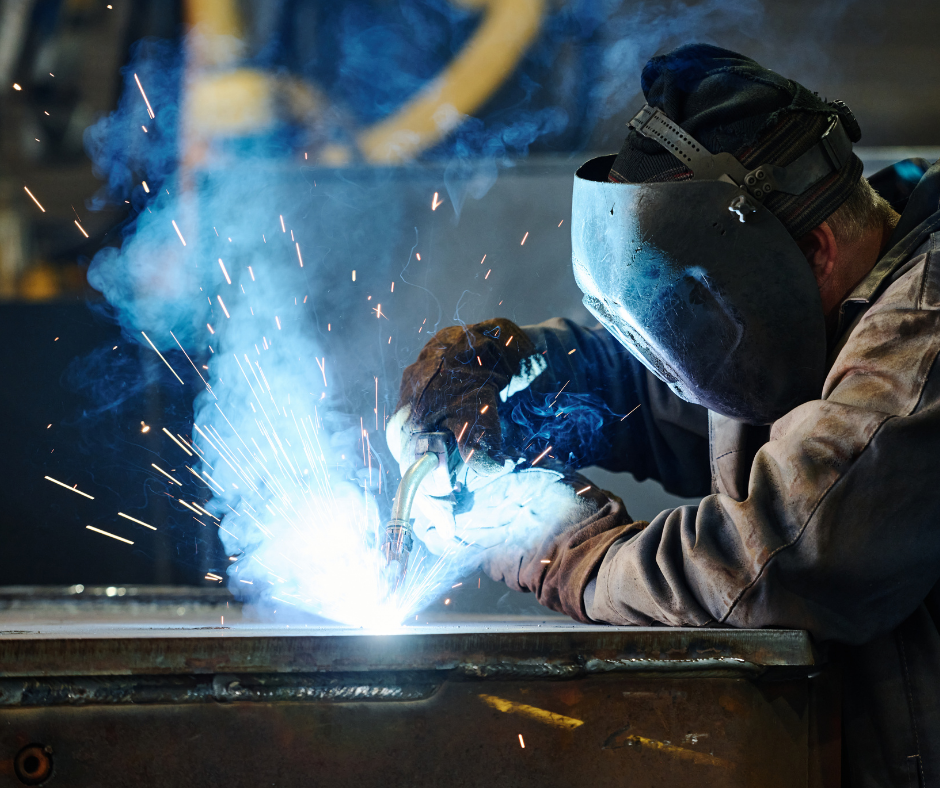
- The Design Challenge: Engineers must size dust collectors to handle the system’s static pressure.
- Eldridge Feature: Eldridge utilizes proprietary Fluid Flow Analysis software to model these complex environments. Instead of guessing, they model the entire ventilation system to ensure that fans provide the exact pressure (up to 8” SP in some models) needed to overcome duct resistance and filter loads.
Engineering for Safety: Design Features That Matter
A compliant system is only as good as its weakest component. When designing for OSHA standards, several technical features are non-negotiable:
1. Explosion-Proof (XP) Motors
In environments with flammable dust or vapors (like paint booths or chemical plants), a standard motor can become an ignition source.
- Eldridge Standard: Eldridge fans come with standard TEFC motors but offer explosion-proof fan construction and motors as critical safety upgrades for hazardous zones.
2. Makeup Air and Static Pressure
A common mistake in industrial design is “exhausting the building to a vacuum.” If you pull air out without bringing fresh air in, the static pressure increases, fans work harder and move less air, and doors become difficult to open.
- Design Feature: Eldridge’s Direct Drive Supply Fans or Louver/Damper systems work to balance the building’s pressure, ensuring that exhaust systems operate at peak efficiency.
3. Noise Control
While moving air is the priority, OSHA also regulates noise exposure (1910.95). High-velocity fans can easily exceed 90 decibels.
- Eldridge Integration: Unlike companies that only sell fans, Eldridge integrates Silencers and Sound Attenuating Equipment into their ventilation designs. This ensures that while you are meeting air quality standards, you aren’t inadvertently violating noise safety standards.
The Importance of Maintenance and Monitoring
OSHA 1910.94(d)(8) requires employers to maintain all ventilation systems in good repair and to test them at least every six months.
What to Monitor:
- Static Pressure: A sudden increase in pressure at the fan often indicates a duct blockage or a clogged filter.
- Capture Velocity: Use anemometers to ensure the air is still moving at the required speed (i.e., 100 to 200 fpm for welding fumes) at the face of the hood.
- Visual Inspection: Check for “visible spurts of dust” or damaged ducting.
Creating a Successful Environment
OSHA ventilation requirements are more than just a checklist; they are a blueprint for a productive, healthy workforce.
Whether you are retrofitting an old foundry with Heavy Duty Industrial Fans or designing a new offshore rig using certified Marine Fans, the goal remains the same: a system that is efficient, quiet, and—above all—safe.
Ready to audit your facility’s air quality? Contact the ventilation specialists at Eldridge USA to start your fluid flow analysis today.