
Protecting Productivity During Extreme Heat
Cities across Arizona, Nevada, California, and Texas experienced record-shattering highs this March, and NOAA reported that it was the warmest March on record for the continental United States. Forecasters are closely monitoring a developing El Niño pattern that could contribute to additional heat through the remainder of 2026 and into 2027.
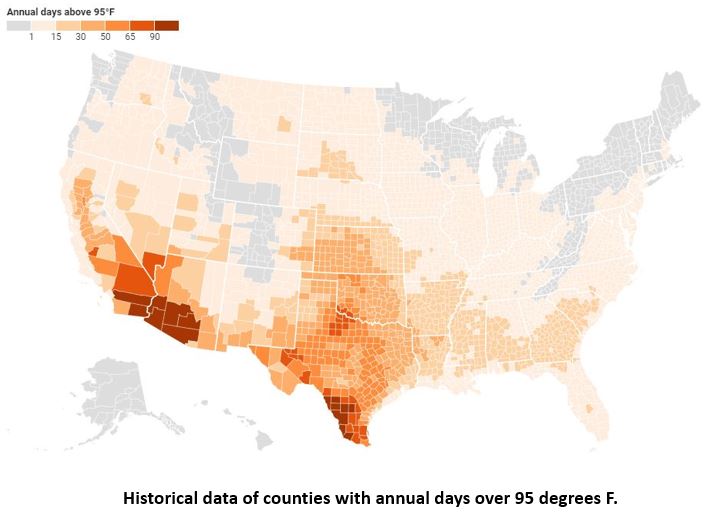
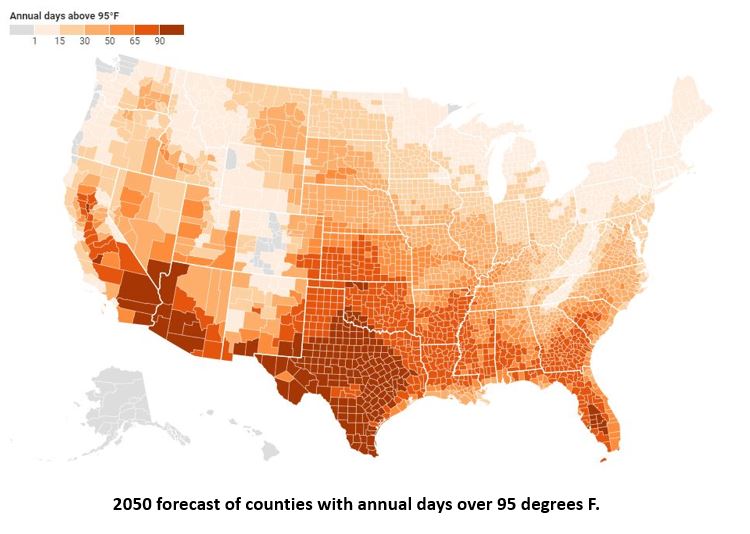
The maps below from the US Global Change Research Program compare historical days above 95°F with projected future conditions
Rising temperatures are more than a seasonal inconvenience for industrial facilities. They can impact worker safety, productivity, retention, and operating costs. At Eldridge, we’ve seen firsthand how the right comfort cooling strategies can help facilities stay ahead of extreme heat while creating safer, more productive work environments.
How Rising Temperatures Affect Productivity
Based on a Lawrence Berkeley National Laboratory study, worker productivity decreases by approximately 1% for every degree Fahrenheit above 77°F. That means a facility operating at 95°F could experience productivity losses approaching 18%. As extreme heat events become more frequent, those losses can quickly add up.
Rising temperatures don’t just affect output. They can also impact workforce health and stability through:
- Increased employee fatigue
- Higher absenteeism rates
- Greater employee turnover
- Increased risk of heat-related illness and injury
Better Work Environments Start with Comfort Cooling
Unlike traditional air conditioning, comfort cooling focuses on improving worker comfort, safety, and productivity without necessarily cooling the entire facility.
In most industrial facilities, two primary heat loads contribute to employee discomfort:
Solar Heat Gain
Solar heat gain occurs when sunlight hits the outside of the building, particularly the roof. Without adequate ventilation, that heat accumulates inside the facility and gradually migrates down into occupied work areas.
A properly designed ventilation system removes this trapped heat before it can impact workers. By providing the appropriate airflow based on the facility’s heat load, the solar heat gain will be dissipated, and the temperature inside will be the same as outside.
Excess Ambient Heat
Excess ambient heat refers to the outdoor air temperature itself when it rises above levels that are comfortable for workers.
To help combat excess ambient heat, comfort cooling solutions focus on improving how workers experience their environment. HVLS (High Volume, Low Speed) fans and spot cooling fans create airflow that promotes sweat evaporation, helping workers feel significantly cooler without changing the actual air temperature. Depending on humidity levels, this perceived cooling effect can make conditions feel 8 to 10 degrees cooler.
For facilities requiring additional cooling, direct and indirect evaporative cooling systems can provide large volumes of cooler air with significantly lower operating costs than traditional air conditioning.
The Benefits of Comfort Cooling
Investing in comfort cooling delivers benefits beyond employee comfort. Facilities that improve workplace conditions often see:
- Improved productivity
- Better employee retention
- Reduced absenteeism
- Lower recruiting and training costs
- Fewer heat-related incidents
- Improved employee morale
When productivity gains, improved retention, and reduced absenteeism are factored in, comfort cooling projects often deliver a surprisingly short payback period.
Eldridge Protects People, Products, and Processes
If your employees are struggling with excessive heat, now is the time to evaluate whether your facility is prepared for increasingly frequent and intense heat events.
At Eldridge, we can help you develop a comfort cooling strategy that improves worker comfort, supports productivity, and protects your operation from the growing challenges of extreme heat. Our team evaluates each facility’s unique heat loads, airflow requirements, and operational challenges to develop practical solutions that improve worker comfort while protecting equipment and processes.
Beat the heat before it beats your productivity. Contact Eldridge today to explore comfort cooling systems tailored to your facility.