
If your facility has busy doorways, loading docks, or large openings, chances are you are losing a significant amount of air conditioning every single day and paying for it on your energy bill. Every time a door opens, heated or cooled air rushes out and outside air rushes in. Over the course of a year, that thermal transfer can quietly drain thousands of dollars from your operating budget.
Air curtains offer a proven, low maintenance solution to this problem. By creating an invisible barrier of fast-moving air across an opening, they dramatically reduce thermal exchange without restricting the movement of people, equipment, or product. For industrial facilities, warehouses, food processing plants, and other large commercial operations, air curtains can be one of the most cost-effective investments available.
In this blog we’ll discuss how they work and why air curtains can cut your facility’s energy bills.
The Hidden Cost of Open Doors
In most industrial environments, doors and loading bays aren’t just opened occasionally. They’re opened hundreds of times a day. Forklifts move in and out. Delivery trucks pull up. Workers move between interior and exterior spaces constantly. Each opening creates an exchange of air that your HVAC or ventilation system then must compensate for.
In warm climates like Texas and the Gulf Coast, this means your cooling systems are working overtime against a relentless influx of hot, humid air. In colder regions or during winter months, heated air bleeds out through every opening. Either way, your energy systems are bearing the burden.
Traditional solutions such as strip curtains, fast roll up doors, and enclosed vestibules all have their place, but they also introduce friction into the flow of operations. Strip curtains wear out and get damaged. Fast doors require maintenance and create bottlenecks. Vestibules take up floor space. Air curtains eliminate the tradeoff between energy efficiency and operational flow.
How Air Curtains Work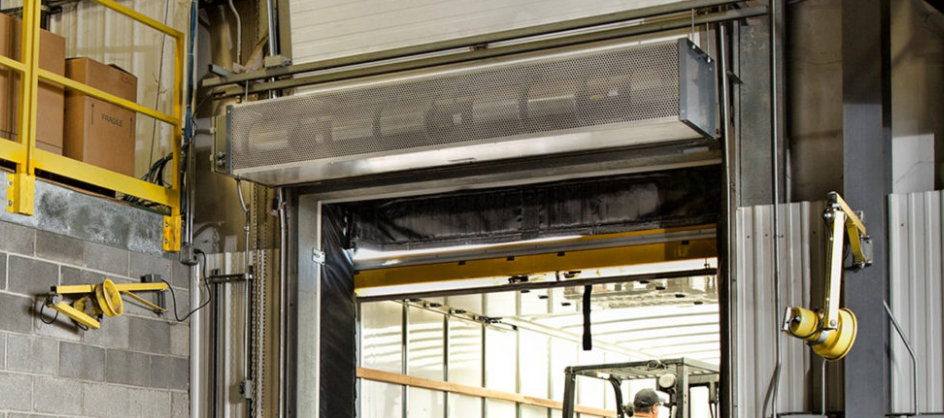
An air curtain is installed above a doorway or opening and projects a precisely engineered stream of air downward across the full width of the opening. This fast-moving air stream acts as an invisible barrier, preventing the mixing of interior and exterior air without physically blocking the opening.
The key to an air curtain’s effectiveness lies in matching the velocity and volume of the air stream to the specific opening size, door height, and ambient conditions of the facility. An undersized or poorly specified unit won’t create an effective seal. An oversized unit wastes energy and can create discomfort. This is why proper selection and design — not just installation — determines how much energy you actually save.
Modern air curtain designs also allow for heated air curtains, which introduce a layer of warm air at the entrance to further offset infiltration losses during colder months, compounding the energy benefit.
Quantifying the Energy Savings
The energy savings from air curtains depend on several variables: the size of the opening, how frequently it’s used, the local climate, and how aggressively the facility is conditioned. That said, the numbers can be substantial.
Studies and field data consistently show that properly specified air curtains can:
- Reduce air infiltration through doorways by 60% to 80%
- Cut heating and cooling energy losses at open doorways by up to 70%
- Deliver payback periods as short as one to two years in facilities with heavy door traffic
For a large warehouse with multiple active dock doors in a hot climate, these savings translate into thousands of dollars annually — per door. Across an entire facility, the cumulative impact on the energy budget is significant.
Beyond Energy: Additional Benefits That Pay Off
Energy cost reduction is the primary financial driver, but air curtains deliver several other operational benefits that add to the total value equation.
- Improved worker comfort. Eliminating blasts of hot or cold air at entry points makes working conditions more comfortable near doorways, which can reduce fatigue and improve productivity.
- Insect and contaminant control. The air stream acts as a barrier against flies, dust, and airborne debris — a critical benefit for food processing facilities where hygiene and compliance requirements are strict.
- Protection of processes sensitive to temperature. In environments where maintaining consistent temperature or humidity is essential to product quality, air curtains help keep conditioned zones stable even when traffic flow is high.
- Reduced HVAC wear and maintenance. When your cooling or heating system isn’t constantly fighting infiltration, it cycles less frequently and experiences less wear — extending equipment life and reducing maintenance costs.
Getting the Specification Right
The difference between an air curtain that delivers measurable savings and one that underperforms almost always comes down to specification. The key factors to get right include:
- Opening dimensions. The air curtain must cover the full width and height of the opening to form an effective seal. Gaps at the edges allow infiltration to bypass the barrier entirely.
- Air velocity and volume. These must be matched to the height of the installation and the pressure differential between inside and outside the facility.
- Heated vs. unheated units. Heated air curtains provide added benefit in colder climates and during winter months. Unheated units are often sufficient in warm climates focused primarily on cooling efficiency.
- Application environment. Food processing, chemical, and pharmaceutical environments may require specialized units built to hygiene standards or with materials that resist corrosion.
At Eldridge, we don’t just sell air curtains — we help customers select, size, and specify the right solution for their specific opening, climate, and operating conditions. The goal is always to deliver the performance that was promised, not just equipment that was shipped.
Is Your Facility a Good Candidate?
Air curtains tend to deliver the highest return on investment in facilities that share one or more of the following characteristics:
- Facilities with frequent door cycles, including multiple openings per hour or near continuous traffic
- Large openings such as loading docks, drive through bays, or oversized entry doors
- Significant temperature differential between interior and exterior environments
- Active HVAC or refrigeration systems working to maintain interior conditions
- Food processing, pharmaceutical, or cleanroom environments with air quality requirements
If your facility checks any of those boxes, an air curtain assessment is worth the conversation.
Talk to Eldridge About Your Facility
Eldridge has been solving industrial ventilation and air quality challenges for 80 years. Our team can assess your facility’s openings, evaluate your current energy losses, and specify an air curtain solution designed to deliver real, measurable savings — not just on paper, but on your monthly energy bills.
Contact us today for a free site survey. We’ll help you understand where your facility is losing air conditioning and what it would take to stop it.